SCAM AWARENESS EDUCATION SERIES
Suspicious Domain Patterns That Almost Always Mean Fraud
A domain name is a “digital storefront.” Just as you might be wary of a store with a flickering neon sign in a dark alley, certain patterns in a URL address are immediate red flags.
Fraudsters rely on obfuscation—the art of making something look like what it isn’t. Here is a guide to the domain patterns that almost always signal a scam.
1. Cybersquatting & Typosquatting
Hackers register domains that are visually similar to famous brands, banking on the fact that users often skim text rather than reading every character.
Character Swapping: Replacing a letter with a similar-looking number or symbol (e.g.,
g00gle.cominstead ofgoogle.com).Common Typos: Registering
amzon.comorfaceboook.com.Homoglyph Attacks: Using non-Latin characters that look identical to Latin ones (e.g., using a Cyrillic “а” instead of a standard “a”).
2. The “Subdomain” Trap
Fraudsters often hide the real destination by burying it behind a legitimate-looking subdomain. Your browser reads URLs from right to left to determine the actual owner.
The Pattern:
wellsfargo.secure-login.comThe Reality: The actual domain here is
secure-login.com, not Wells Fargo. The “wellsfargo” part is just a subdomain created by the attacker to trick your eyes.
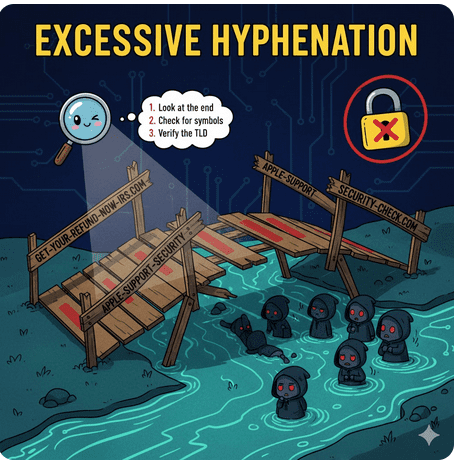
3. Excessive Hyphenation
Legitimate brands rarely use multiple hyphens in their primary domain. It’s a common tactic used to bypass spam filters or create a sense of false urgency.
Red Flag:
get-your-refund-now-irs.comorapple-support-security-check.com.Why it’s suspicious: Major corporations invest heavily in short, memorable branding. If a URL looks like a full sentence separated by dashes, it’s likely a phishing landing page.
4. Unconventional TLDs (Top-Level Domains)
While .com, .org, and .net are the gold standards, there are now hundreds of TLDs available. Scammers often flock to “cheap” or “unregulated” extensions because they are inexpensive to register in bulk.
High-Risk TLDs:
.top,.xyz,.work,.rest,.tk.The Context: While a startup might legitimately use
.ioor.ai, a bank or a government agency will never contact you from a.zipor.supportdomain.
5. Keyword Stuffing
Scammers often pack as many “trust” words into a URL as possible to lower your guard.
| Suspicious Pattern | Example |
| Urgency Keywords | verify-account-now.com |
| Security Keywords | security-update-portal.com |
| Financial Keywords | tax-refund-portal-gov.com |
Summary Checklist for Domain Safety
Before entering any credentials, perform this 3-second check:
Look at the end: Identify the “Root Domain” (the word immediately to the left of the
.comor.org).Check for symbols: Are there random hyphens or numbers where there shouldn’t be?
Verify the TLD: Is it a standard extension for that type of business?
Pro Tip: If you are unsure, do not click the link. Manually type the official address into your browser or use a trusted bookmark.
Remember, awareness is your strongest defense.
Contact us if you’d like more information on how cyber intelligence can help you locate scammers.
Please share this guide with friends and colleagues.
Stay up to date on the latest scam company alerts.
Advanced cyber tracking and profiling technology can identify where they are hiding.
Get in touch today and receive a free phone consultation.

GlobalMarkets AC Clone Website globalmarketsac.com

Seyrkule Luxembourg unauthorized trading website
ANF Luxembourg S.A. Clone Website

Lucrumia Group lucrumiaofficial.co Unauthorized Trading App
Freetradeeuropa.com et al Illegal Trading Websites
Forum One Imposter Clone Website forumone.eu.com

Zureon Global zureonglobal.com Unauthorized Trading
Logan Investment SA Luxembourg loganinvestment.lu Clone Website
Clairmontfils clairmontfils.com Unauthorized Website
