
SCAM AWARENESS EDUCATION SERIES
Fake vs Real Website: Visual Comparison
The ability to distinguish a legitimate website from a sophisticated clone is a vital skill. Scammers don’t just build websites. They build “mirrors” designed to reflect your expectations while quietly siphoning your data.
This guide provides a side-by-side visual breakdown. It will help you spot a fake website before you click “buy” or “login.”
1. The Anatomy of a URL (The First Defense)
The address bar is the most honest part of any website. Scammers use a technique called typosquatting—registering domains that are visually similar to famous brands.
| Feature | Real Website | Fake Website |
| Domain Name | amazon.com | amaz0n.com (zero instead of ‘o’) |
| Subdomains | https://www.google.com/search?q=login.microsoft.com | https://www.google.com/search?q=microsoft.security-update.com |
| Extension | .com, .gov, .edu | .biz, .top, .xyz, .shop |
| Security | Always starts with https:// | May use http:// (but many now use https) |
Pro Tip: Look at the text immediately before the last dot (e.g., in
wellsfargo.secure-login.com, the actual domain issecure-login.com, not Wells Fargo).
2. Visual Quality and Consistency
Legitimate companies spend millions on branding. Scammers often “scrape” images from the real site, resulting in a loss of quality.
Low-Res Logos: Look for pixelation or “fuzziness” around the edges of the company logo.
Stretched Images: Product photos may appear distorted or have mismatched aspect ratios.
Font Inconsistency: Real sites use a consistent set of fonts. If the font changes mid-sentence or looks like a basic default font (like Times New Roman on a tech site), be wary.
Broken Layouts: On a fake site, buttons might overlap, or text might bleed off the edge of the screen, especially on mobile devices.
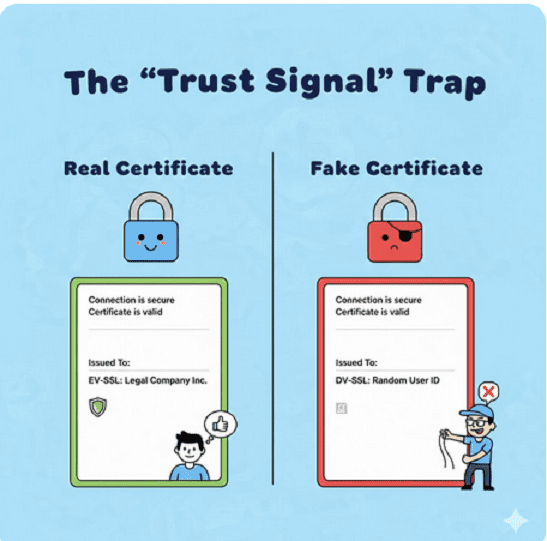
3. The “Trust Signal” Trap
For years, we were told to “look for the padlock.” Today, many phishing sites use SSL certificates (the padlock) to appear safe.
How to Check the Certificate Properly:
Click the Padlock icon in the address bar.
Select “Connection is secure” then “Certificate is valid.”
The Real Test: Check the “Issued To” field. A real bank will have an “EV” (Extended Validation) or “OV” certificate showing the legal company name. A fake site will usually have a generic “DV” (Domain Validated) certificate issued to an anonymous entity.
4. Content and Language Red Flags
AI has made scammers better at writing, but they still make “hustle” mistakes because they want to launch sites quickly.
Urgency Tactics: “Your account will be DELETED in 2 hours!” or “Only 3 items left at 90% off!”
Strange Grammar: Phrases that feel “translated” (e.g., “Kindly proceed to secure your funds”).
Broken Navigation: Try clicking the “About Us,” “Privacy Policy,” or “Terms of Service” links at the bottom. On fake sites, these often do nothing or refresh the current page.
5. Payment and Contact Discrepancies
Before you enter your card details, look at the “Contact Us” page and the checkout.
Payment Methods: Real stores take Credit Cards. Fake stores often prefer non-reversible payments: Zelle, Venmo, Wire Transfers, or Cryptocurrency.
Physical Address: Search the address from the “Contact” page. Many scammers use random residential addresses or empty lots.
The “Gmail” Test: If a “corporate” site lists a contact email like
support-brandname@gmail.cominstead of@brandname.com, it is almost certainly a scam.
Quick Checklist for Every New Site:
[ ] Is the URL spelled 100% correctly?
[ ] Does the “About Us” page sound like it was written by a human?
[ ] Are the prices “too good to be true”? (e.g., a $1,200 MacBook for $299).
[ ] Do the social media icons actually link to active profiles?
Remember, awareness is your strongest defense.
Contact us if you’d like more information on how cyber intelligence can help you locate scammers.
Please share this guide with friends and colleagues.
Stay up to date on the latest scam company alerts.
Advanced cyber tracking and profiling technology can identify where they are hiding.
Get in touch today and receive a free phone consultation.


BANK OF GLENDALE Warning | bankofglendale.com

Ventotrade (ventotrade.com) Warning
Obelisk Wealth Warning

Harbor Valtrix Warning
Wealth Vision (wealth-vision.net) Warning

Global Option Trading | Stocks Market Finance Warning

Smart Trades Global | SmartsTradesGlobal.com Warning

Windfall Trade Warning | Windfalltrades.com
